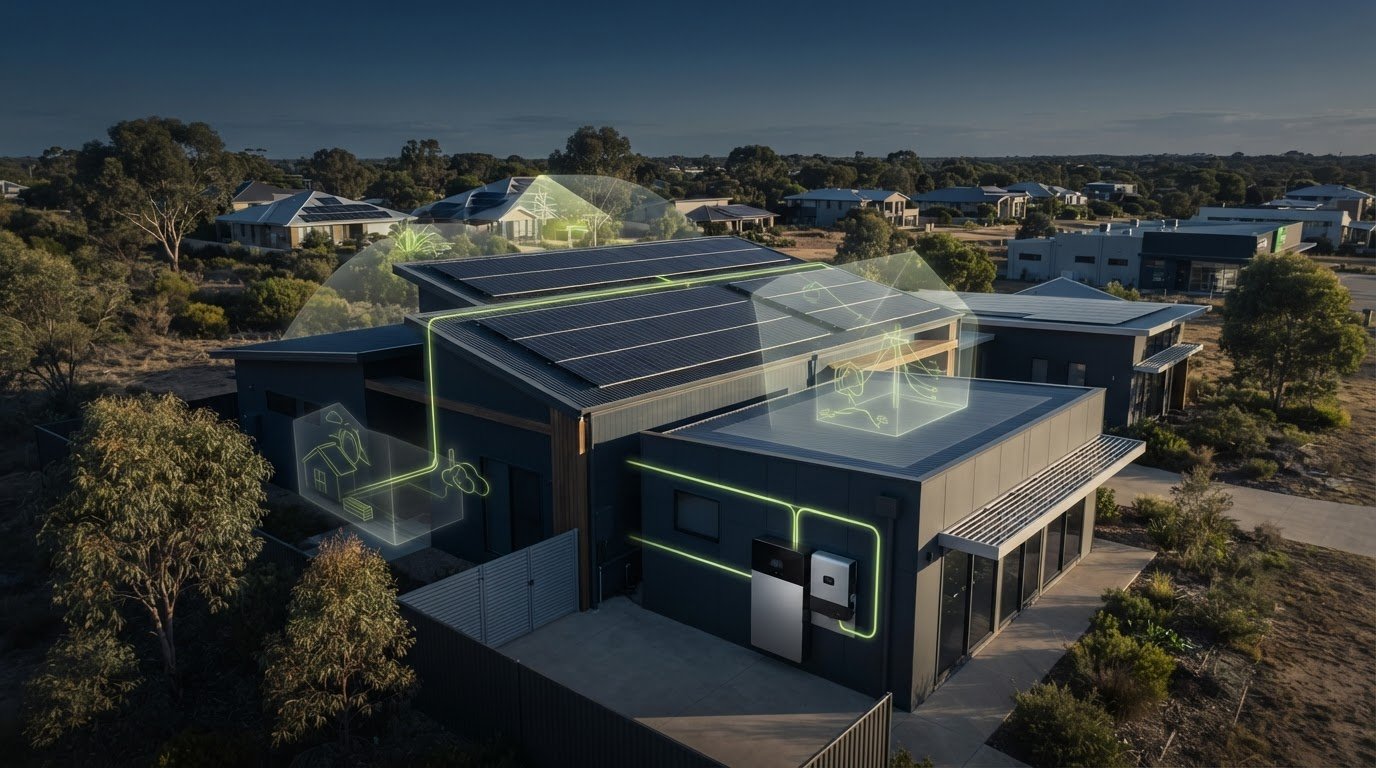
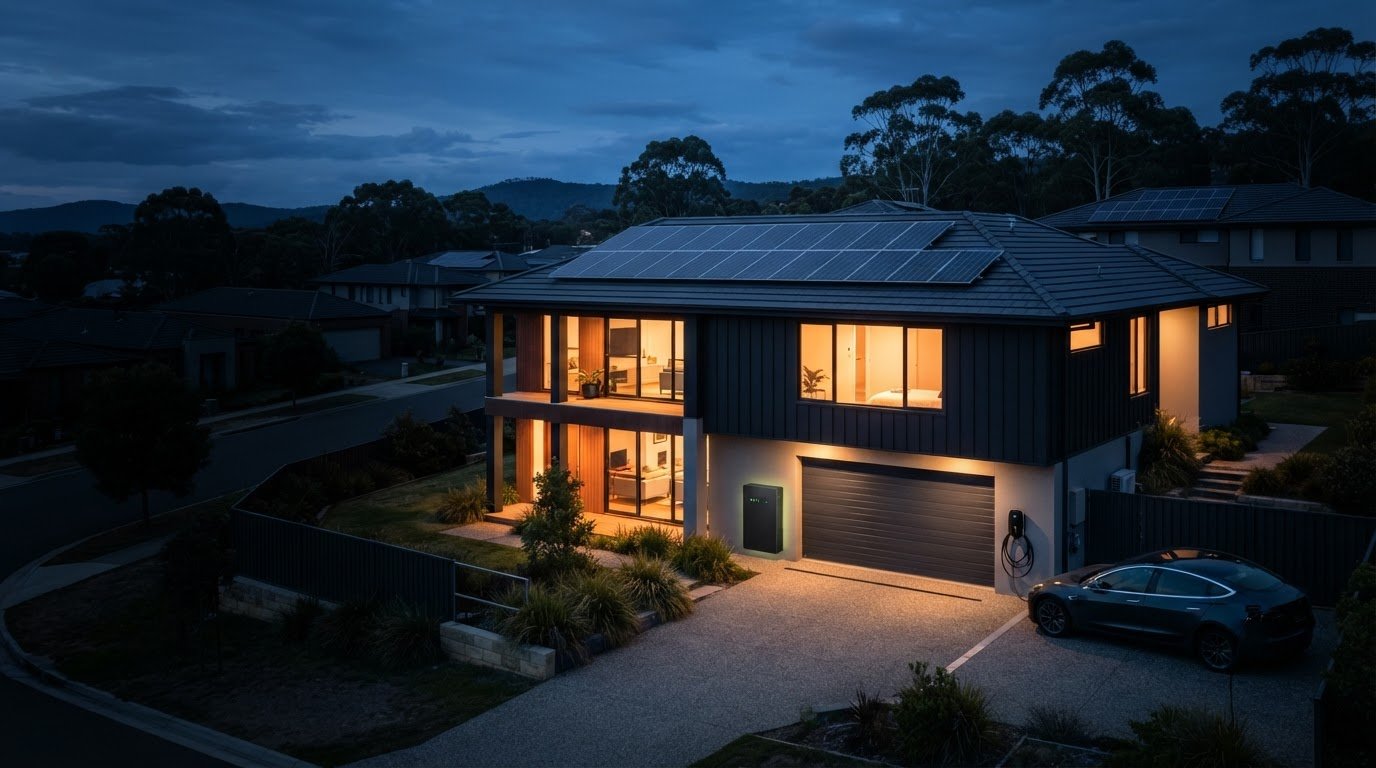
Aussie Solar Packages and Backup Power for Australian Homes
A solar system doesn’t automatically keep a home running during a blackout. An Aussie solar setup needs a battery to store energy, and outage power also depends on compatible backup equipment and dedicated backup circuits. Solar panels and battery storage are separate decisions, so the system design needs to match how the household uses energy and what it needs to keep operating.
A solar package should explain more than panel capacity: equipment, battery options, installation, support and backup-power limits all matter. This guide outlines what to consider in a package, how to assess customer ratings, and what to understand about Australian incentives and support. It also explains how backup systems work during outages, helping you assess practical fit before making a decision.
Key Takeaways
- Assess panels, inverter and battery as a complete system, and account for any existing equipment when planning an upgrade.
- Read customer ratings for specific details about value, equipment, installation and service rather than relying on an overall score alone.
- Installation approval requirements vary with the property, system size, electricity distributor and local regulations.
- Blackout backup requires compatible equipment and dedicated backup circuits; battery storage alone does not ensure outage power.
- Australian federal, state and territory incentives may reduce the upfront cost of solar and batteries, with the Cheaper Home Batteries Program able to reduce home battery costs by thousands of dollars.
Solar system packages and equipment specifications
A rooftop solar package combines generation equipment with an inverter and, where required, battery storage. For commercial projects, compare the design with site demand, existing equipment and the intended operating mode.
Solar Package Specifications
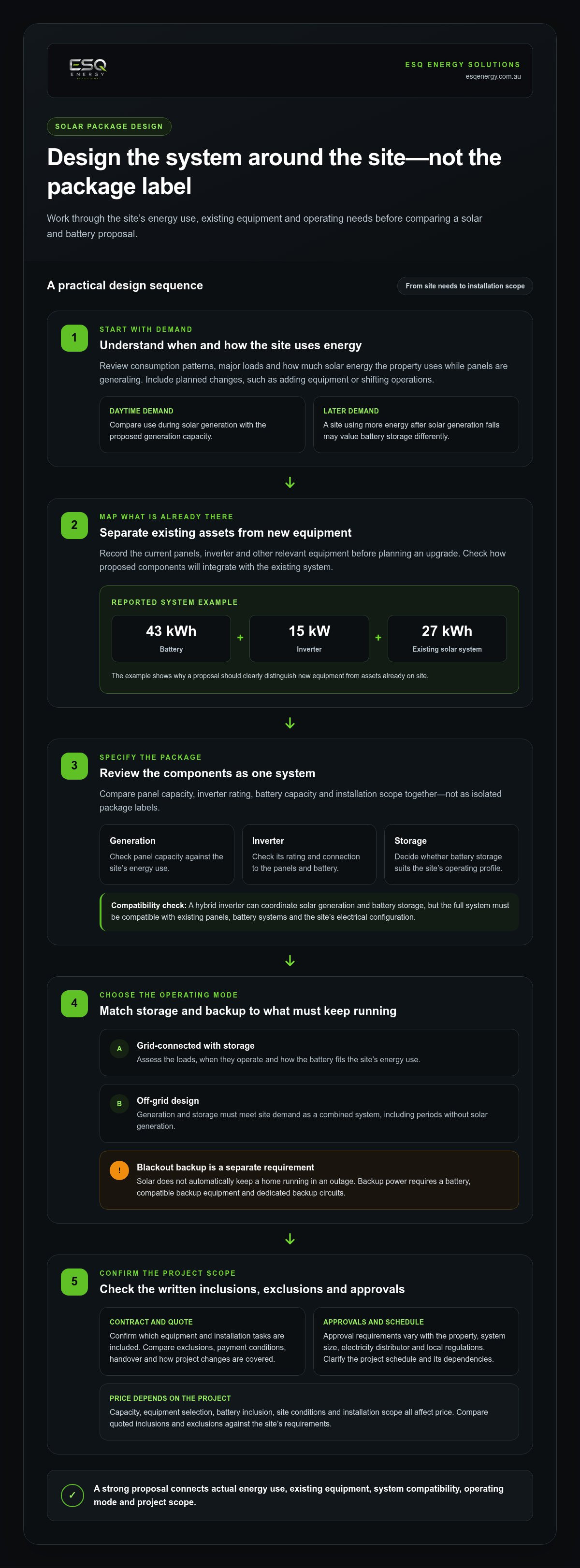
Review the panel capacity, inverter rating, battery capacity and installation scope as one package. A customer report dated 21 March 2026 described a 43 kWh battery with a 15 kW inverter alongside an existing 27 kWh solar system. That example shows why proposals should distinguish new equipment from assets already on site.
For an Aussie solar project, read the equipment schedule alongside the contract. Confirm which components are included, how the inverter integrates with existing generation, and whether battery storage is part of the design. The ACCC advises consumers to read contracts or agreements carefully and ask their supplier questions before committing.
System Sizing for Household Energy Use
System sizing starts with the site’s energy use, not a standard package label. Review consumption patterns, the timing of major loads and how much solar energy the property uses while panels are generating. These details help determine generation capacity and whether a battery suits the site’s operating profile.
For example, a site that uses more energy after solar generation falls may value battery storage differently from one with substantial daytime demand. Compare the proposed system with actual usage records and planned changes, such as adding equipment or shifting operations. This ties the design decision to real demand.
Hybrid inverters and compatibility: A hybrid inverter can coordinate solar generation and battery storage, but the full system must be compatible. Check the inverter’s connection to existing panels, battery systems and site electrical configuration. When adding storage to an established array, map the current inverter and equipment before selecting components; the 43 kWh battery example illustrates how an upgrade can sit alongside existing solar.
Off-grid systems: An off-grid design operates without relying on a grid connection, so generation and storage must meet the site’s energy demand as a combined system. Assess which loads need power, when they operate and how the system will manage periods without solar generation. Off-grid solar is a distinct design choice, not simply a rooftop package with a battery added.
Reported system prices: A system’s price depends on its capacity, equipment selection, battery inclusion, site conditions and installation scope. The price is specific to the project and is provided after a quote request. Compare the quoted inclusions and exclusions, then assess how each component supports the project’s energy requirements rather than comparing package labels alone.
Solar installation approval requirements in Australia depend on the property, system size, electricity distributor and local regulations. Include these factors in project planning: assess the site, define the equipment configuration, then account for applicable approvals before installation.
Installation timing is another point to confirm when reviewing a package. One customer reported that installation took 3 weeks less than the initial estimate. Treat that experience as an individual report, and clarify the expected schedule for the project, including any site or equipment dependencies.
Customer ratings for value, system quality, installation and service
Before signing an Aussie Solar quote or installation contract, compare the equipment, installation scope, exclusions and payment conditions. The ACCC advises consumers to read agreements carefully and ask their supplier questions before committing. Match each promised component and task to the written terms, including how the agreement covers project changes and handover.
Customer reviews can show how installation and service unfolded, but a dated account is not a complete performance assessment. Look for specific details about the installed system, project communication and completed work. Separate comments about value from claims about equipment quality or installation timing. This makes reviews easier to compare with the requirements in your proposal.
Two customer accounts provide dated examples: one reviewer described an Aussie Solar Batteries installation on 29 September 2026, and another dated an installation account 9 September 2026. These dates establish when the accounts were written, not a rating score or a consistent result across projects. Read the details in each account rather than treating individual feedback as a universal measure.
A customer reported on 22 January 2026 that installation finished three weeks earlier than the initial estimate. That is one customer’s account, not a standard timeframe. Project duration can depend on design, site access, equipment and approval requirements. Compare the proposed schedule with the work stages and dependencies in the agreement, including any stated assumptions that affect sequencing.
For solar panel installation, assess whether the proposal explains the system layout, equipment, installation scope and handover. For a solar battery, review how storage integrates with the existing or planned system. These details make comments about system quality more useful: compare the reviewer’s experience with the equipment and work relevant to your project.
Installation safety and compliance depend on the project. In Australia, approval requirements vary with the property, system size, electricity distributor and local regulations. Identify the approvals and installation responsibilities set out for the project, then compare them with its schedule. A general customer review cannot establish that another property has the same requirements.
Home EV charger installation adds another equipment interface to assess. Check how the proposed charger fits the property’s electrical setup and whether the installation scope explains the work and handover. A review mentioning an EV charger is most useful when it describes the installation itself, rather than only overall service or value.
Use a consistent review checklist: note the account date, equipment described, installation experience, service communication and any stated timing. Then compare those details with the written quote. For rooftop solar, project-specific scope matters more than a broad star rating because site conditions and system configurations differ.
For a structured assessment of solar, storage or charging requirements, energy system advisory can help connect equipment choices with project needs.
The customer reported that installation took three weeks less than the initial estimate. Treat this as an account of one project, then assess value, system quality and service against the equipment, scope and commitments in your own quote. Look for concrete descriptions of completed work and follow-up, rather than relying on broad praise or criticism.
Australia-wide service availability
Australia-wide solar work involves more than moving equipment to a property. Each commercial rooftop has distinct site conditions and an electricity distributor, so a multi-site programme needs a national delivery plan and location-specific project assessment. Record each property’s address, roof access constraints, existing electrical infrastructure and relevant distributor before sequencing surveys, approvals, equipment delivery and installation.
If you’re assessing coverage, map every proposed installation location before comparing project schedules. A site register can capture property details, access requirements, existing electrical systems and project stage. This gives teams a practical view of where design, approvals, equipment logistics and installation need separate coordination. A shared programme can track common milestones while preserving each site’s technical scope.
For a portfolio spanning different parts of Australia, group sites for planning while keeping their technical records separate. For example, rooftops with similar access constraints may be scheduled together, but each property still needs its own design information and connection details. This supports consistent oversight without assuming separate sites have identical equipment requirements or approval pathways.
Use a coverage assessment to test operational readiness, not just map service locations. Define who coordinates site assessment, design, equipment logistics, installation and handover, then match those responsibilities to each property. A business with warehouses across metropolitan and regional areas needs site-level planning for both, rather than relying on a national label to explain delivery.
- List every site: Capture the property address, roof access and existing electrical infrastructure.
- Identify the distributor: Record the electricity distributor relevant to each connection.
- Separate technical records: Link each site’s design, equipment schedule and approval documents to its property.
- Coordinate delivery stages: Track surveys, approvals, equipment and installation against each site’s requirements.
That discipline matters for grid compliance. Australian approval requirements depend on the property, system size, electricity distributor and local regulations. A national project plan should account for these variables at every site, rather than applying one assumed connection process across the portfolio.
For a business planning installations across Australia, start with a portfolio-level site register, then develop each rooftop scope separately. This gives project teams a clear basis for sequencing work, coordinating local requirements and comparing progress across locations. National coordination is useful when the plan preserves the technical and administrative conditions that apply to each property.
Backup power during outages
A solar battery can supply power during a blackout only when the system has compatible backup equipment and dedicated backup circuits. A battery connected for everyday energy use does not, by itself, keep a rooftop solar system operating during an outage. For a commercial site, the design must define which circuits receive backup power and how the system separates them from the grid.
Start with an outage load schedule. List the equipment that must remain operational, such as communications hardware, security systems, refrigeration or selected lighting. Then identify the circuits serving those loads. This makes the backup requirement specific: a site seeking to maintain one server room has different priorities from a warehouse seeking to run several operational areas.
Dedicated backup circuits determine which parts of the property can draw stored energy during an outage. Map them to the intended loads during system design, rather than assuming every circuit is covered. For example, a business may nominate network equipment and emergency lighting while excluding non-essential office equipment. The final circuit plan sets the limits of backup coverage.
Equipment compatibility is the next design test. Confirm that the battery, inverter and backup equipment work together as an integrated system. Existing rooftop solar can affect the configuration, so document the current inverter and electrical arrangement before planning an upgrade. Backup operation depends on the complete system, not the battery alone.
Set the operating priority before installation. First identify critical loads, map their circuits, then specify the equipment needed to supply them during outages. This sequence aligns the technical design with the site’s continuity requirements. It also distinguishes reducing grid reliance during normal operation from maintaining selected loads when grid supply is unavailable.
- Define critical loads: Name each device or operational area that needs outage power.
- Map dedicated circuits: Link those loads to the circuits intended for backup.
- Review system compatibility: Consider the battery, inverter, backup equipment and existing solar configuration together.
- Document exclusions: Identify which site loads will not receive backup supply.
For a site with several operational zones, this load-by-load approach prevents broad backup expectations from being mistaken for whole-property supply. A battery system designed for selected circuits supports the nominated loads; it does not mean every machine, outlet or building service will operate during a blackout.
Before committing to a backup design, compare the circuit schedule with the site’s outage priorities and system configuration. The design should state which loads the backup arrangement serves and how solar, battery storage and compatible backup equipment operate together. That scope gives facilities teams a practical basis for managing energy reliance during grid interruptions.
What Australian rebates and incentives can reduce the cost of an Aussie Solar system?
Australian households may have access to incentives for solar panels and home batteries. The Australian Competition and Consumer Commission (ACCC) notes that federal, state and territory governments offer incentives for consumers purchasing these systems. For a commercial rooftop project, assess the system and relevant jurisdiction separately rather than assuming a household incentive applies.
The Australian Cheaper Home Batteries Program can reduce the upfront cost of a home battery by thousands of dollars. Its stated scope is home batteries, so commercial project planning should distinguish this programme from incentives intended for residential purchases. This prevents a household battery benefit from being treated as an assumed reduction in a business project’s capital requirement.
Incentives can differ by government and by the type of equipment being purchased. The ACCC’s description covers solar panels and home batteries across federal, state and territory governments, but does not establish that every programme applies to every installation. Start by identifying the project location, whether it is residential or commercial, and whether the proposed system includes panels, battery storage or both.
For an Australian commercial rooftop installation, treat incentives as a separate line of enquiry, not a guaranteed financial input. First define the system scope and site. Then identify the government level associated with any incentive and the equipment it relates to. Finally, compare the project’s financial assessment with and without that potential contribution. This keeps the underlying project case separate from an incentive that may not apply.
- Classify the project: Record whether the system serves a home or commercial property.
- Identify the equipment: Separate solar panels from battery storage in the project scope.
- Locate the site: Note the state or territory and relevant government level.
- Keep assumptions distinct: Don’t include a residential battery benefit as assumed commercial funding.
For homeowners, the Cheaper Home Batteries Program is an example of an incentive that may reduce upfront battery costs by thousands of dollars. For businesses, assess the project against incentives relevant to its property type and equipment. The distinction matters: a residential programme and a commercial rooftop system are not interchangeable categories.
Keep the incentive assessment alongside the system design, rather than letting it determine equipment selection by itself. A battery or panel configuration still needs to fit the site’s energy requirements. The property type, location and equipment scope provide the starting points for an informed incentives review.
Review your solar and battery project with an energy advisory assessment that considers system scope and project requirements.
ESQ Energy Solutions: Energy Advisory
ESQ Energy Solutions helps assess commercial energy requirements and align system planning with operational priorities. Its Energy Advisory service supports decisions about Solar, Battery Storage and EV Charging, including how these technologies fit a site’s energy use and project scope.
Turn to energy advisory when comparing rooftop solar configurations, planning battery integration or assessing charging infrastructure alongside generation. A structured review can clarify the requirements that inform system design and investment decisions, without treating every site as the same project.
For a considered next step on commercial rooftop solar and grid compliance, contact ESQ Energy Solutions.
Set your next energy decision in motion
Make the next step a clear project brief. Define what the home needs from its energy system, how that need may change and which outcomes matter most. A well-framed brief gives equipment decisions a practical reference point and keeps the design aligned with household priorities. Your Aussie solar plan should support how you intend to use energy, not simply add equipment without a defined purpose.
ESQ Energy Solutions offers Energy Advisory, Solar and Battery Storage to support system planning and implementation. Energy Advisory can help translate household requirements into a considered project direction, while solar and battery choices are assessed as connected parts of the overall system.
Bring your priorities and project requirements into the next discussion, then identify the decisions to resolve before proceeding. A clear starting point supports a considered investment and a system designed around your needs.
Contact ESQ Energy Solutions to discuss your energy project and take the next step with confidence.
Frequently Asked Questions
Why add solar batteries to your home?
A home battery stores surplus solar generation for use when panels aren’t producing, such as during evening household demand. This can increase the share of solar energy used on site and reduce reliance on grid electricity. The practical case depends on when the home consumes power, how much generation is otherwise exported and whether storage capacity aligns with that usage pattern.
What batteries and inverters do you use?
ESQ Energy Solutions’ battery storage systems feature Sigenergy technology. Assess the inverter configuration against the solar array, battery and electrical design to ensure the components work as a compatible system. The appropriate inverter model and capacity depend on the system configuration. Review the equipment schedule to understand the roles of the nominated battery and inverter in the proposed setup.
Frequently Asked Questions
Why add solar batteries to your home?+
A home battery stores surplus solar generation for use when panels aren’t producing, such as during evening household demand. This can increase the share of solar energy used on site and reduce reliance on grid electricity. The practical case depends on when the home consumes power, how much generation is otherwise exported and whether storage capacity aligns with that usage pattern.
What batteries and inverters do you use?+
ESQ Energy Solutions’ battery storage systems feature Sigenergy technology. Assess the inverter configuration against the solar array, battery and electrical design to ensure the components work as a compatible system. The appropriate inverter model and capacity depend on the system configuration. Review the equipment schedule to understand the roles of the nominated battery and inverter in the proposed setup.