10kW Solar System: How to Size, Assess Output and Plan for Performance
A 10kW solar system may produce far less useful energy for your property than its headline capacity suggests. The 10kW rating describes the system’s power capacity, not the kilowatt-hours it will generate over a day. Actual output depends on site conditions, while the value of that generation depends on when your household or business uses energy.
It’s understandable to compare a system with your current electricity use and expect the numbers to line up. But roof orientation, pitch and shading, seasonal conditions, daytime demand and export limits all shape how much solar generation you can use. A single daily-output estimate can’t account for those factors.
This guide explains the difference between capacity and energy produced, the site and consumption data needed for a credible assessment, and when a 10kW solar system may warrant comparison with another system size or battery storage. You’ll see how an engineering assessment connects your energy profile, site conditions and expected generation, so the design is based on your property rather than a generic estimate.
Key Takeaways
- A 10kW solar system’s rated capacity isn’t a daily energy guarantee. Kilowatts and kilowatt-hours measure different things.
- Roof orientation, tilt, shading, weather and panel temperature all influence generation.
- Compare system capacity with your load profile, daytime energy use and available roof area to assess whether it suits your home or business.
- Validate the design using consumption data and site-specific assumptions. Assess panel count and roof area against the selected modules and layout.
- ESQ Energy Solutions connects energy advice, engineering, procurement, installation and ongoing system management across a solar project.
What a 10kW Solar System Means for Australian Sites
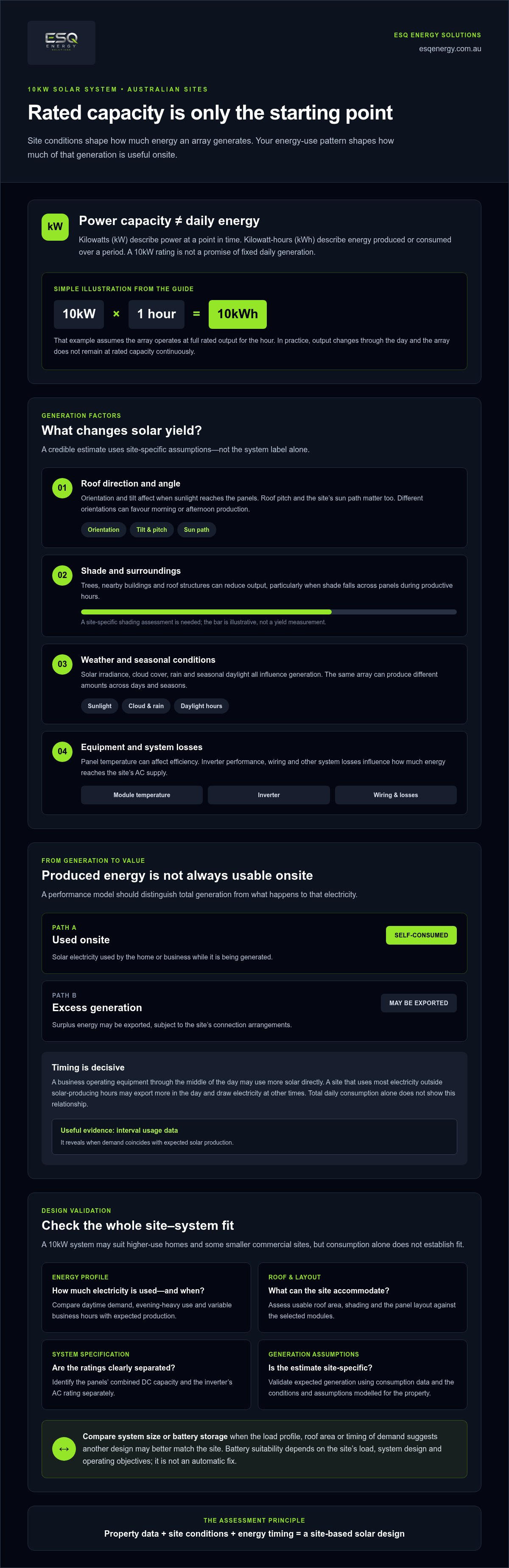
A 10kW solar system is a solar array with a rated power capacity of 10 kilowatts under specified test conditions. It does not produce a fixed amount of energy each day. The rating describes power at a point in time, while generation accumulates over time and varies with sunlight and site conditions. That distinction matters when comparing a system’s capacity with a property’s energy use.
Kilowatts (kW) measure power. Kilowatt-hours (kWh) measure energy produced or consumed over a period. As a simple illustration, a 10kW array operating at its full rated output for one hour would generate 10kWh. In practice, output changes throughout the day, and the array won’t remain at its rated capacity continuously. Assess daily energy generation against the specific site rather than inferring it from the system label.
The label also needs context. In Australia, solar discussions and reporting cover both installed capacity and electricity generation. The overview of Solar power in Australia illustrates why these are distinct measures. For an individual property, the design should make clear which capacity is being quoted and what assumptions underpin expected generation.
Does 10kW Describe the Panels or the Inverter?
Panel capacity and inverter rating refer to different components. The panels’ combined rated capacity is generally expressed as DC power, because they generate direct current. The inverter converts that electricity to alternating current (AC) for use by site equipment or export. Its rating describes the AC power it can convert, not the total DC capacity of the panels.
These ratings don’t have to match exactly. Their relationship depends on the system design, site requirements and expected operating conditions. A proposal should identify the array’s DC capacity and the inverter’s AC rating separately. Treating one figure as a description of both can obscure how the system is configured. No single inverter arrangement is appropriate for every 10kW solar system.
Who Might Consider a 10kW Solar System?
A 10kW solar system may suit higher-use homes and some smaller commercial sites. Examples include properties with substantial daytime demand or businesses that operate equipment during solar-producing hours. But total consumption alone doesn’t establish fit. A site that uses most of its electricity after sunset has a different match between generation and demand from one with steady daytime loads.
Review when electricity is used as well as how much is consumed. An evening-heavy household load, daytime business operations and variable opening or production hours can each lead to different design priorities. Available roof area and usable panel layout also constrain what can be installed. The capacity label is a starting point for assessment, not proof that the system is correctly sized for the site.
How a 10kW Solar System’s Output Changes Across Australian Conditions
A system’s rated capacity is not a forecast of its daily generation. Solar output rises and falls as sunlight, weather and operating conditions change, so the same array can produce different amounts across days and seasons. A national average or broad daily estimate can help frame a discussion, but it can’t account for a particular property’s roof, surrounding obstructions or equipment.
Actual solar yield depends on site conditions, including solar irradiance, panel orientation and tilt, shading, seasonal daylight, cloud cover, module temperature, equipment selection and system losses. A credible estimate starts with the site and the assumptions used to model its performance, not just the capacity printed on a system specification.
Which Site Conditions Have the Greatest Effect on Solar Yield?
Orientation and tilt affect how directly sunlight reaches the panels over the day. An array facing towards the morning sun may generate more earlier, while a different orientation may favour afternoon production. Roof pitch also changes the panels’ angle to the sun. These factors need to be considered together with the site’s sun path and the periods when energy is most valuable.
Shading from trees, nearby buildings or roof structures can reduce output, particularly when it falls across panels during productive hours. Cloud, rain and seasonal changes in daylight also affect generation. Panels can operate less efficiently at higher temperatures, while inverter performance, wiring and other system losses affect how much energy reaches the site’s AC supply.
Why Estimated Output Is Not the Same as Usable Solar Energy
Estimated generation is the total energy produced by the system over a period. Usable solar energy depends on what happens to that generation: electricity consumed onsite is self-consumed, while excess generation may be exported, subject to the site’s connection arrangements. A performance model should assess these outcomes separately.
Timing is decisive. A business with equipment running through the middle of the day may use a larger share of its solar generation directly. A site that uses most of its electricity outside solar-producing hours may export more during the day and draw electricity at other times. Total daily consumption alone won’t show this relationship. Interval usage data can reveal when demand coincides with expected production.
Battery storage is a separate design consideration. It may change how generation is used at different times of day, but its suitability depends on the site’s load, system design and operating objectives. It shouldn’t be treated as an automatic fix for a mismatch between generation and demand.
For a 10kW solar system, a site-specific yield assessment should document its assumptions, account for seasonal variation and distinguish total generation from onsite use and exports. A site-specific solar assessment connects those yield estimates with the property’s energy profile, giving the design a stronger basis than a generic output claim.
Is a 10kW Solar System the Right Size for Your Energy Profile?
A 10kW solar system is a capacity to assess against the site, not a default recommendation for every high-use property. The relevant comparison combines when electricity is consumed, how much demand can coincide with solar generation, and whether the available roof can accommodate a suitable array. For a commercial site, operating schedules matter as much as annual consumption.
The table shows how the same nominal capacity can present different design questions across common site types. Use these as starting points for assessment, not conclusions about system suitability.
| Site profile | Potential fit | Key constraint | Useful assessment data |
|---|---|---|---|
| Higher-use home | May suit a household with substantial daytime demand. | Evening-heavy use may not align with generation; roof space and shading can limit layout. | Interval consumption, daytime appliance use and usable roof area. |
| Daytime-operated business | May align with regular operating loads during solar hours. | Load peaks may not coincide with generation, or roof space may be limited. | Interval data, equipment schedules, operating days and roof plan. |
| Variable-hours site | Could suit sites with some consistent daytime demand. | Changing shifts, seasonal operations or shutdown periods can alter demand. | Interval data across representative periods, operating calendar and planned load changes. |
Match System Capacity to When Energy Is Used
Two sites with similar annual consumption can have different solar requirements. A business running refrigeration or production equipment through the day may use generation as it occurs. A household or venue with demand concentrated in the evening may have less direct overlap. Annual bills show the scale of use, but usually don’t reveal its timing. Operating schedules and interval data help map demand against expected generation and show where a capacity change may improve alignment.
When Should You Compare 10kW With Another System Size?
Model alternatives if roof area restricts panel placement, shading reduces usable sections, or export limits could constrain surplus generation. These factors can make a smaller or differently configured system more practical than simply maximising installed capacity. Future electrification, such as planned EV charging or new electric equipment, may also change the load profile and support a different design.
Higher capacity doesn’t automatically mean better economics. Additional generation may not deliver equivalent value if it exceeds onsite demand and export conditions limit its use. Compare options using verified consumption patterns, site-specific yield assumptions, expected self-consumption and export treatment. Any financial conclusion depends on those inputs and project-specific modelling, not capacity alone. This comparison gives the design a clear operational basis before the next stage of assessment.
How to Validate a 10kW Solar System Design Before Installation
A credible design translates consumption and site conditions into documented system choices and yield assumptions. For a 10kW solar system, panel count and roof area aren’t universal figures: both depend on the selected modules, their dimensions and the final array layout. A staged assessment separates measured inputs from estimates and identifies what still needs engineering review.
The Site and Consumption Data to Assemble
Start with evidence about how the property uses energy and what the site can accommodate. Gather interval consumption data and bills, operating schedules, and known future loads such as planned equipment or EV charging. Record roof dimensions, orientation, obstructions, shading and structural constraints. Label each item as measured, documented or assumed so an estimate doesn’t present an unverified input as a site fact.
The Design Checks That Shape a Reliable Yield Estimate
Review the proposed array layout against the roof and shading information, then check module selection, inverter configuration and the losses used in the yield model. Confirm that the design’s grid-connection and export assumptions reflect the project’s applicable network conditions and current requirements. Document the model inputs and expected generation so monitored performance can be compared with the original forecast on a consistent basis.
Credible yield estimates connect site measurements and load data with transparent design assumptions. Use the following sequence to validate a proposal before installation:
- Establish the consumption baseline. Review interval data and bills across representative operating periods. Note daily and seasonal changes, demand peaks, business hours and unusual shutdowns that could distort a typical profile.
- Map current and planned loads. Record equipment schedules and expected changes, including electrification or expansion. Keep confirmed loads distinct from proposed ones so the design can show how future scenarios affect sizing.
- Verify site conditions. Document roof measurements, orientation, obstructions and shading across relevant parts of the day. Identify structural constraints for engineering review rather than assuming every roof section is usable.
- Test the array layout. Check how selected module dimensions fit the available roof, including spacing and access needs. Derive panel count and occupied area from the actual module and layout, not a generic rule of thumb.
- Review system configuration. Confirm the relationship between array capacity and inverter configuration, and identify the losses included in the generation estimate. The design should state the assumptions behind its projected output.
- Validate connection and export inputs. Treat network connection conditions and export settings as project-specific design inputs. Verify applicable requirements and assumptions against current information before finalising the design.
- Record the performance baseline. Retain the forecast, inputs and modelling assumptions. This creates a reference for comparing monitored generation with expected performance after commissioning.
This structured review gives the design team a clear basis for resolving gaps before procurement and installation. Arrange a site-specific solar design assessment to connect your energy data, roof conditions and yield assumptions.
How ESQ Energy Solutions Delivers a 10kW Solar Project
A sound solar project links the property’s energy profile to a design that can be delivered and managed as an asset. ESQ Energy Solutions provides energy advisory, engineering, procurement and installation across residential and commercial projects. This end-to-end approach connects assessment, system design and delivery, with continuity through the project lifecycle.
System capacity is only one design input. A 10kW solar system may be a suitable starting point for assessment, but the recommended array and expected output depend on the site, its energy use and relevant design constraints. ESQ’s advisory work assesses usage profiles and efficiency opportunities to inform a project-specific design rather than treating a capacity label as a complete specification.
From Energy Profile to Installed Solar Asset
The process begins with understanding how and when energy is used. That profile informs system design and project planning alongside site conditions and expected generation. Engineering translates these inputs into a design, then procurement and installation carry the project through delivery. Coordinating these stages supports continuity between the original assessment and the installed solar asset.
Capacity and yield are specific to each project assessment. The design needs to reflect the property’s operating profile and physical conditions, with assumptions documented to show the basis for expected performance. This is especially relevant for commercial sites, where operating hours and equipment use can shape how generated energy aligns with demand.
Ongoing Operations and Project Next Steps
Installation is one stage in an asset’s lifecycle. ESQ’s managed energy operations include monitoring, optimisation and lifecycle maintenance. These activities provide an ongoing framework for reviewing system operation and managing the asset over time. They don’t remove the need for realistic design assumptions or guarantee a particular generation outcome.
Battery integration can also be assessed as a separate design option against site requirements, energy-use patterns and project objectives. It should form part of an overall system assessment rather than being assumed to suit every solar installation. The appropriate configuration depends on how the site uses energy and what the project is intended to achieve.
A site-specific assessment connects energy use, system design and expected generation before project delivery proceeds. Discuss a solar system assessment with ESQ Energy Solutions to establish the design considerations for your property or commercial site.
Turn the System Size Into a Site-Specific Decision
Move from a capacity target to a project brief grounded in the property’s actual operating profile. Assess a 10kW solar system against the site’s energy use, physical constraints and performance objectives before fixing the design. This gives decision-makers a clearer basis for comparing system options and planning for future changes in demand.
ESQ Energy Solutions delivers residential and commercial solar projects from advisory through installation, with managed energy operations that include monitoring, optimisation and lifecycle maintenance. This connects the initial project assessment with ongoing asset management and performance review over the broader project lifecycle.
Bring together the available consumption and site information, then use a site-specific assessment to define the next design decisions. Discuss a site-specific solar assessment with ESQ Energy Solutions to move forward with a design shaped around your property and energy profile.
A clear project brief is a practical foundation for a well-considered solar investment.
Frequently Asked Questions
Does a 10kW solar system produce 10kWh every hour?
No. A 10kW rating describes power capacity, not a guaranteed hourly output. The array would generate 10kWh over an hour only if its average output stayed at 10kW throughout that hour, which operating conditions don’t assure. For example, an hour that starts with strong sun and ends under cloud will produce a different amount. Review interval generation data to understand how output changes through the day.
Can a 10kW solar system export all its electricity to the grid?
It may export some or, at times, all of its generation, but this depends on site demand and the connection’s export settings. Network conditions can limit how much power is allowed to flow back to the grid, and the system’s configuration may respond to those limits. For instance, if site demand is low during a sunny period, surplus generation may be exported only up to the applicable limit.
What happens to a 10kW solar system during a blackout?
A standard grid-connected solar inverter generally shuts down during a grid outage to prevent electricity being sent into the network while it’s being repaired. Solar panels alone therefore don’t necessarily keep a property powered in a blackout. Backup operation depends on the system being designed with suitable isolation and backup capability, and on which circuits it supports. The design documentation should specify what remains operational during an outage.
Is a battery required with a 10kW solar system?
No. A battery isn’t essential for a 10kW solar system to generate electricity. Whether storage is useful depends on the site’s demand patterns and how the project is intended to operate. For example, a site that needs energy after solar production falls may assess storage differently from one that uses most of its electricity during the day. Battery integration is a separate design decision, not an automatic requirement.
Will a 10kW solar system generate its full rated capacity on a cloudy day?
Not necessarily. Cloud reduces the sunlight reaching the panels, so output usually varies with cloud density and movement. The array may continue generating in diffuse light, but its instantaneous output can sit well below its rated capacity. Brief cloud breaks can also cause generation to fluctuate within the same day. Assess performance over a suitable period rather than treating one cloudy-day reading as evidence of a system fault.
How often does a 10kW solar system need maintenance?
Maintenance timing depends on the equipment, site conditions and the maintenance schedule specified for the system. Use monitoring data to identify persistent changes in generation, and arrange an inspection if faults, damage or unusual performance appear. Keep records of servicing and repairs so trends can be reviewed over time. ESQ Energy Solutions’ managed energy operations include monitoring, optimisation and lifecycle maintenance for solar assets.
Frequently Asked Questions
Does 10kW Describe the Panels or the Inverter?+
Panel capacity and inverter rating refer to different components. The panels’ combined rated capacity is generally expressed as DC power, because they generate direct current. The inverter converts that electricity to alternating current (AC) for use by site equipment or export. Its rating describes the AC power it can convert, not the total DC capacity of the panels. These ratings don’t have to match exactly. Their relationship depends on the system design, site requirements and expected operating conditions. A proposal should identify the array’s DC capacity and the inverter’s AC rating separately. Treating one figure as a description of both can obscure how the system is configured. No single inverter arrangement is appropriate for every 10kW solar system.
Who Might Consider a 10kW Solar System?+
A 10kW solar system may suit higher-use homes and some smaller commercial sites. Examples include properties with substantial daytime demand or businesses that operate equipment during solar-producing hours. But total consumption alone doesn’t establish fit. A site that uses most of its electricity after sunset has a different match between generation and demand from one with steady daytime loads. Review when electricity is used as well as how much is consumed. An evening-heavy household load, daytime business operations and variable opening or production hours can each lead to different design priorities. Available roof area and usable panel layout also constrain what can be installed. The capacity label is a starting point for assessment, not proof that the system is correctly sized for the site. A system’s rated capacity is not a forecast of its daily generation. Solar output rises and falls as sunlight, weather and operating conditions change, so the same array can produce different amounts across days and seasons. A national average or broad daily estimate can help frame a discussion, but it can’t account for a particular property’s roof, surrounding obstructions or equipment. Actual solar yield depends on site conditions, including solar irradiance, panel orientation and tilt, shading, seasonal daylight, cloud cover, module temperature, equipment selection and system losses. A credible estimate starts with the site and the assumptions used to model its performance, not just the capacity printed on a system specification.
Which Site Conditions Have the Greatest Effect on Solar Yield?+
Orientation and tilt affect how directly sunlight reaches the panels over the day. An array facing towards the morning sun may generate more earlier, while a different orientation may favour afternoon production. Roof pitch also changes the panels’ angle to the sun. These factors need to be considered together with the site’s sun path and the periods when energy is most valuable. Shading from trees, nearby buildings or roof structures can reduce output, particularly when it falls across panels during productive hours. Cloud, rain and seasonal changes in daylight also affect generation. Panels can operate less efficiently at higher temperatures, while inverter performance, wiring and other system losses affect how much energy reaches the site’s AC supply.
When Should You Compare 10kW With Another System Size?+
Model alternatives if roof area restricts panel placement, shading reduces usable sections, or export limits could constrain surplus generation. These factors can make a smaller or differently configured system more practical than simply maximising installed capacity. Future electrification, such as planned EV charging or new electric equipment, may also change the load profile and support a different design. Higher capacity doesn’t automatically mean better economics. Additional generation may not deliver equivalent value if it exceeds onsite demand and export conditions limit its use. Compare options using verified consumption patterns, site-specific yield assumptions, expected self-consumption and export treatment. Any financial conclusion depends on those inputs and project-specific modelling, not capacity alone. This comparison gives the design a clear operational basis before the next stage of assessment. A credible design translates consumption and site conditions into documented system choices and yield assumptions. For a 10kW solar system, panel count and roof area aren’t universal figures: both depend on the selected modules, their dimensions and the final array layout. A staged assessment separates measured inputs from estimates and identifies what still needs engineering review.
Does a 10kW solar system produce 10kWh every hour?+
No. A 10kW rating describes power capacity, not a guaranteed hourly output. The array would generate 10kWh over an hour only if its average output stayed at 10kW throughout that hour, which operating conditions don’t assure. For example, an hour that starts with strong sun and ends under cloud will produce a different amount. Review interval generation data to understand how output changes through the day.
Can a 10kW solar system export all its electricity to the grid?+
It may export some or, at times, all of its generation, but this depends on site demand and the connection’s export settings. Network conditions can limit how much power is allowed to flow back to the grid, and the system’s configuration may respond to those limits. For instance, if site demand is low during a sunny period, surplus generation may be exported only up to the applicable limit.
What happens to a 10kW solar system during a blackout?+
A standard grid-connected solar inverter generally shuts down during a grid outage to prevent electricity being sent into the network while it’s being repaired. Solar panels alone therefore don’t necessarily keep a property powered in a blackout. Backup operation depends on the system being designed with suitable isolation and backup capability, and on which circuits it supports. The design documentation should specify what remains operational during an outage.
Is a battery required with a 10kW solar system?+
No. A battery isn’t essential for a 10kW solar system to generate electricity. Whether storage is useful depends on the site’s demand patterns and how the project is intended to operate. For example, a site that needs energy after solar production falls may assess storage differently from one that uses most of its electricity during the day. Battery integration is a separate design decision, not an automatic requirement.
Will a 10kW solar system generate its full rated capacity on a cloudy day?+
Not necessarily. Cloud reduces the sunlight reaching the panels, so output usually varies with cloud density and movement. The array may continue generating in diffuse light, but its instantaneous output can sit well below its rated capacity. Brief cloud breaks can also cause generation to fluctuate within the same day. Assess performance over a suitable period rather than treating one cloudy-day reading as evidence of a system fault.
How often does a 10kW solar system need maintenance?+
Maintenance timing depends on the equipment, site conditions and the maintenance schedule specified for the system. Use monitoring data to identify persistent changes in generation, and arrange an inspection if faults, damage or unusual performance appear. Keep records of servicing and repairs so trends can be reviewed over time. ESQ Energy Solutions’ managed energy operations include monitoring, optimisation and lifecycle maintenance for solar assets.