
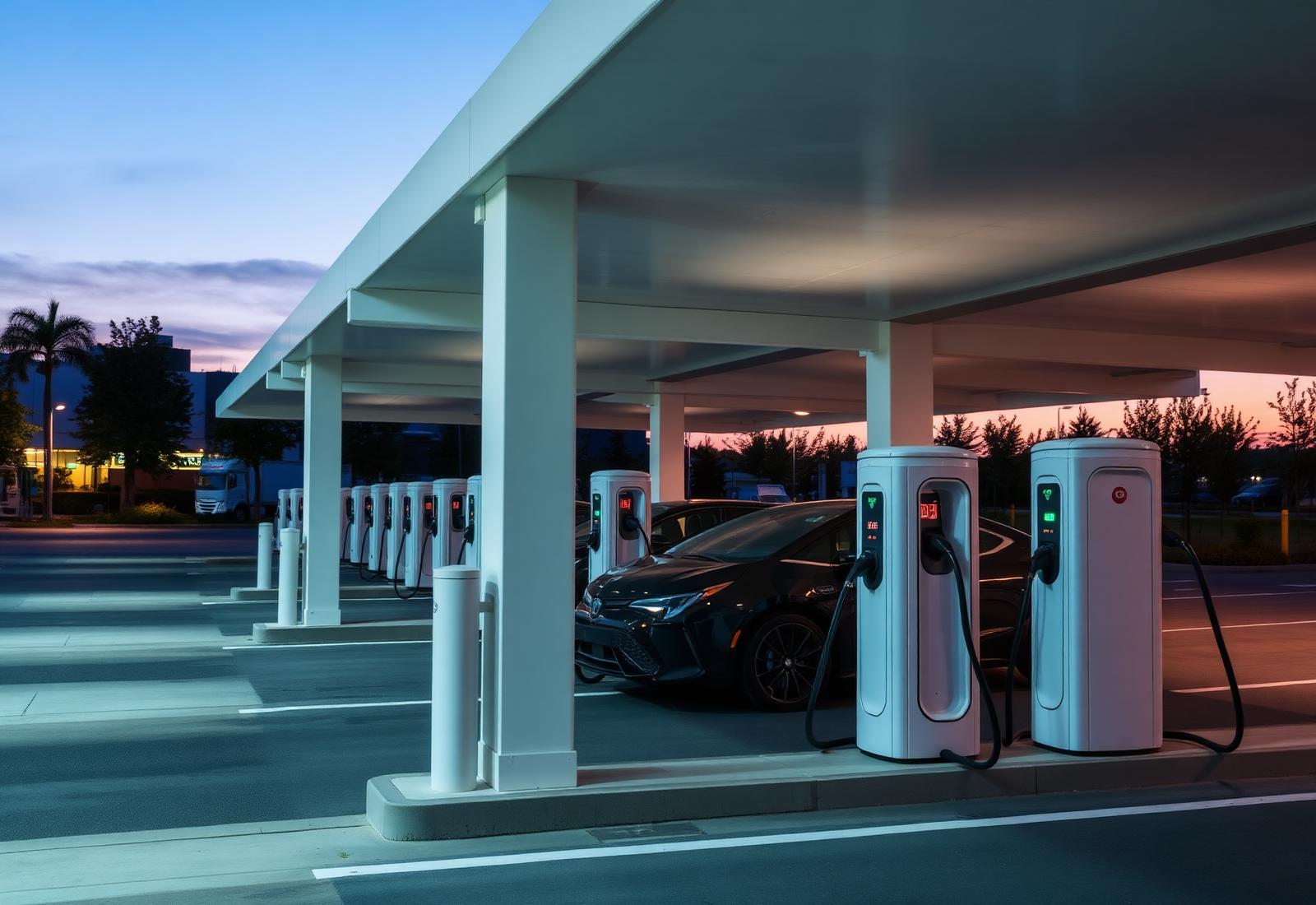
Australia's EV market has reached the point where charging infrastructure is an operating requirement for dealerships, repairers, fleets, workplaces, strata properties and commercial sites. DRIVEN Round 3 offers eligible dealerships and EV repairers support for smart chargers and specialist workshop equipment. Funding is limited and applications are assessed in order of receipt.
01 — What the DRIVEN Round 3 rebate covers
The Dealership and Repairer Initiative for Vehicle Electrification Nationally—DRIVEN—forms part of the Australian Government's Driving the Nation Fund. Round 3 has $18.8 million available nationally for eligible automotive dealerships and EV repairers.
- Fixed smart charger
- Up to $3,000 per eligible plug
- Portable DC charger
- Up to $3,000 per eligible unit
- Charging infrastructure
- $21,000 maximum per site
- Workshop equipment
- Up to 80% of eligible costs
- Combined site rebate
- $50,000 maximum
- Minimum eligible spend
- $5,000 per site per claim
The $21,000 limit applies to charging infrastructure. The $50,000 limit applies to the combined site claim when eligible workshop equipment is included. Funding is not automatic: applicants must satisfy the current guidelines and retain evidence of expenditure.
View the official DRIVEN program and application details →02 — Eligibility dates and technical requirements
Eligible fixed chargers must have been purchased and installed by a licensed electrician on or after 26 March 2024. Eligible EV-specific workshop equipment, tools, personal protective equipment and lifting equipment must have been purchased on or after 12 May 2026. Relevant charging equipment must comply with AS 5732:2022.
Before lodging a claim, retain:
- Tax invoices and payment records.
- Charger model, serial number and technical documentation.
- Electrical installation and commissioning evidence.
- Licensed electrician details and evidence of purchase dates.
- Workshop equipment specifications and compliance information.
- A clear allocation of costs to each site and claim.
Applications are scheduled to close at 5pm AEST on 30 April 2027, unless the annual funding allocation is exhausted earlier. Check the official guidelines before purchasing equipment or submitting a claim.
03 — EV growth is changing the charging requirement
More EVs mean more demonstration, customer handover, service-bay and staff charging for dealerships. Repairers need compliant isolation procedures, lifting systems, protective equipment and trained personnel. Fleets face an additional constraint: every vehicle must receive enough energy before its next duty cycle without exceeding the site's available network capacity.
Charging infrastructure is therefore an energy asset. Performance depends on connection design, load management, tariff selection, software connectivity and maintenance—not simply the maximum output of each charger.
04 — The lowest-cost way to charge at home
For many households, the lowest-cost charging strategy combines rooftop solar, a solar-aware smart charger, a suitable electricity tariff and automatic scheduling based on vehicle availability.
| Indicative energy rate | Cost of a 40 kWh charge |
|---|---|
| 4.5 cents per kWh | $1.80 |
| 8 cents per kWh | $3.20 |
These examples exclude supply charges, demand charges and plan conditions. Compare the whole electricity plan—including standard usage rates, feed-in tariff, charging windows and connectivity requirements—not only the advertised EV rate. Solar charging also has an opportunity cost equal to the export credit forgone.
05 — Reducing the cost of charging away from home
Public charging prices can combine energy, session, idle, parking and membership fees. Compare the total session cost rather than only the advertised cents-per-kilowatt-hour rate.
Commercial and fleet sites have different priorities. Public charging requires payment processing, customer access, uptime monitoring and revenue reconciliation. Fleet charging requires vehicle prioritisation, depot scheduling, energy management and operational availability.
OCPP-connected infrastructure can enforce site demand limits, prioritise vehicles, shift charging into solar windows, meter usage and support remote fault diagnosis. ESQ uses network-agnostic charging architecture, dynamic load management and solar-aware dispatch.
06 — Design solar, storage and grid capacity together
Several high-power chargers can create a material new site peak. A fleet depot may require a network study, transformer upgrade, protection coordination, switchboard works or a revised connection agreement. Three controls can reduce that impact:
- Dynamic load management limits charging demand to available site capacity.
- Solar integration directs daytime generation into vehicles.
- Battery storage shifts lower-cost or solar energy into charging peaks and can reduce demand charges.
Correct sizing depends on interval data, charger output, vehicle dwell time, tariffs and network constraints. Installing storage without modelling those factors is not an energy strategy.
07 — An engineered path from application to operation
- Advisory — site assessment, duty-cycle modelling, tariff review and feasibility.
- Engineering — charger selection, load modelling, connection design and protection studies.
- Delivery — electrical and civil works, commissioning and payment configuration.
- Optimisation — solar integration, smart charging and battery dispatch.
- Operations — remote monitoring, maintenance, reporting and lifecycle management.
Where appropriate, ESQ can assess PPA and zero-upfront-capital pathways for eligible commercial projects. Project suitability depends on load, credit, contract and technical requirements.
Plan the charger, connection and operating cost as one system.
Request a preliminary feasibility assessment for dealership, repairer, fleet or commercial EV charging infrastructure anywhere in Australia.